Why do you ask for my email?
The free tester download is offered in exchange for joining the Offline Notes tester list. With your consent, blacklogos stores your email in Resend for tester updates and feedback requests. Cloudflare retains a hashed email identifier and a consent record. No email is automatically sent when you sign up: the download appears on this page. Your email is not connected to your extension notes. You can request removal through GitHub.
Which version am I testing?
This page offers the fixed version 1.4.1 tester build as a versioned ZIP containing the extension runtime and license notices. Unpacked installations do not update automatically.
How do I install the tester build?
After signup, download and extract the ZIP on a desktop computer. In a separate Chrome profile, open chrome://extensions, enable Developer mode, choose Load unpacked, and select the extracted folder containing manifest.json. Keep that folder in place. Start with a non-sensitive article and back up anything you want to keep.
Does Offline Notes upload my notes?
The extension stores notes in chrome.storage.local in your browser profile. It has no account, cloud sync, analytics, or extension network requests. Private comments are entered on extension-owned pages, not in the source website. Visible highlights remain visible to source websites. The website’s email signup is separate. An optional folder mirror writes Markdown to a folder you choose; a sync service may sync that folder. Local storage is not an encrypted vault. Protect your device and keep backups.
Why does Chrome ask for access to websites?
Offline Notes uses website access to capture selected text, extract readable articles, and restore highlights on pages you revisit. Use the popup’s per-site switch to turn capture and highlights off for a site and its subdomains without deleting saved notes. You can also manage site access or disable the extension in Chrome’s extension settings.
Can I read saved articles without internet?
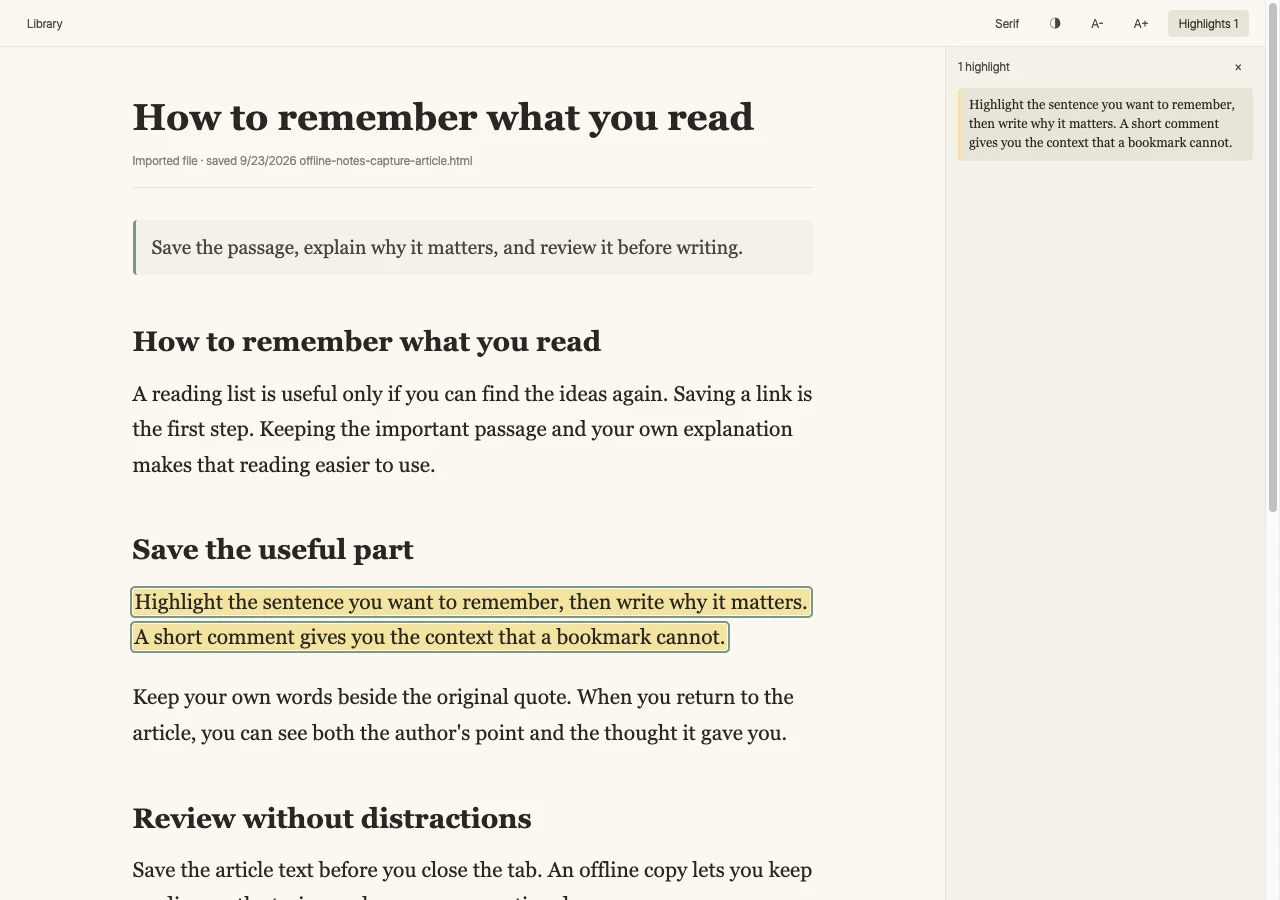
Yes. Open previously saved article text and highlights without an internet connection. Save the article while the source page is available. The offline reader preserves text structure, not a full copy of images, videos, or interactive web pages.
Can I use my notes in Obsidian?
Offline Notes exports Markdown files that Obsidian can read. You can also choose a local folder for Markdown mirroring. This is a write-only, file-based handoff, not two-way sync or an Obsidian plugin. Edits made in that folder do not come back into the extension.
Which import and export formats are supported?
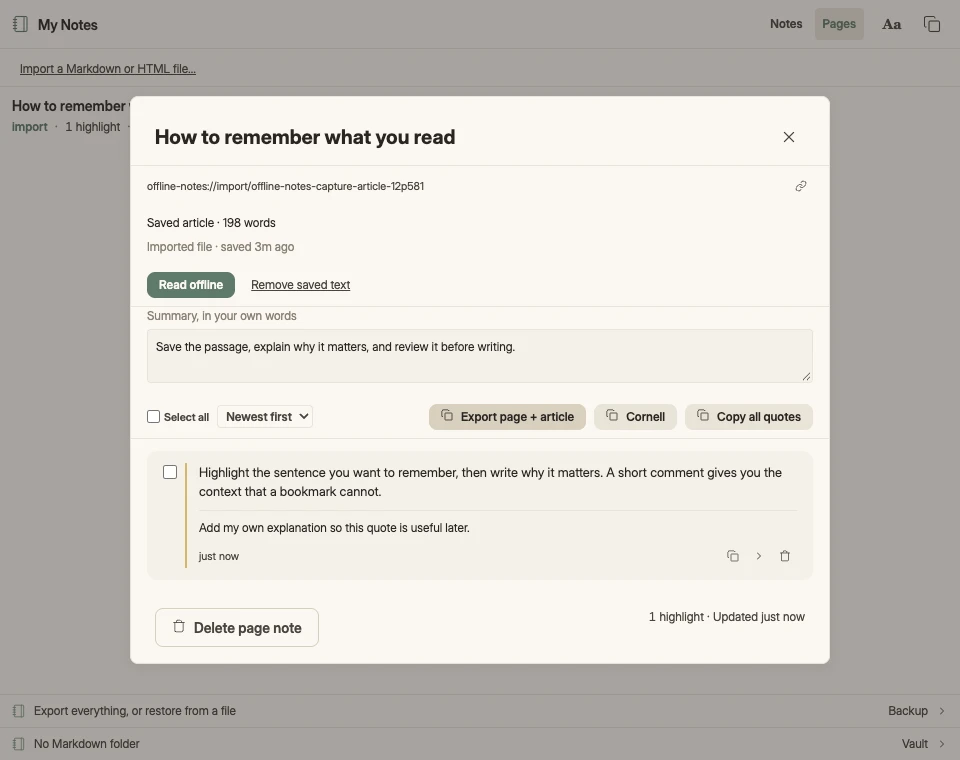
Import Markdown and HTML files as page notes, but not PDFs. Export notes as Markdown, page highlights as a Cornell-style Markdown sheet, or note images as PNG. Use JSON backup and restore to preserve your library.
What limitations should testers expect?
Chrome internal pages and PDF highlighting are not supported. Article saving retries for delayed page content, but some pages cannot be extracted. Unpacked installations require manual updates. Use a separate Chrome profile for testing; do not replace an existing installation with valuable notes without a backup.
Is testing free, and how do I send feedback?
The tester download is free and the source is available on GitHub. Use the Send feedback link to open a GitHub issue; a GitHub account is required. Include your browser version, what you tried, and what happened. Issues are public, so do not post private notes, email addresses, or confidential page content.